Do continuous glucose monitors help people without diabetes?
TL;DR
For people without diabetes or prediabetes, continuous glucose monitors (CGMs) mostly show what researchers already knew: healthy bodies handle glucose within a fairly narrow, self-correcting range. Studies like the one from Stanford's Snyder Lab (Hall et al., 2018, PLOS Biology) confirm that non-diabetic glucose variability is real but small, and there's no strong clinical trial evidence yet that wearing a CGM changes weight, energy, or long-term metabolic outcomes in healthy adults. The verdict: promising as a curiosity and behavior-awareness tool, but under-studied as a health intervention.
What does a CGM actually measure, and why do healthy people want one?
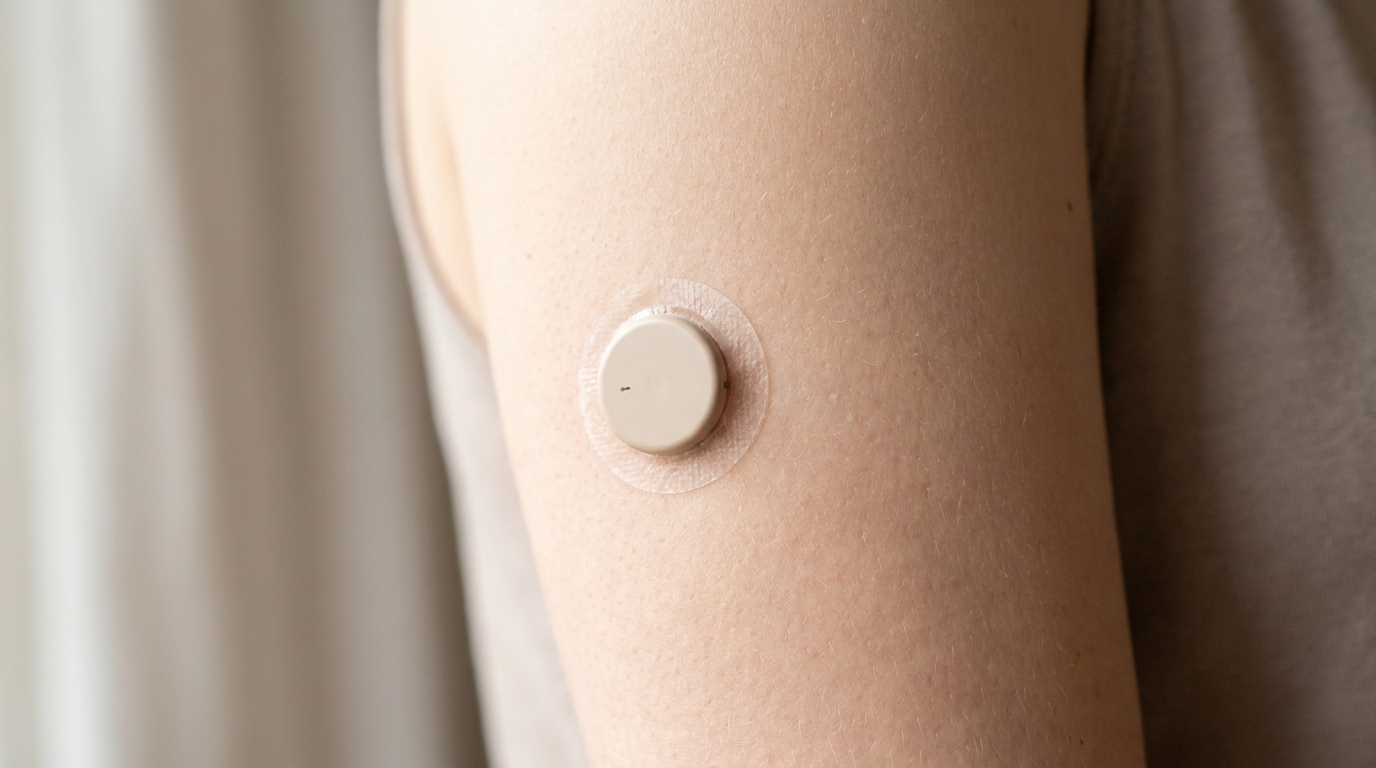
A CGM is a small sensor, usually worn on the upper arm or abdomen, that measures glucose in the interstitial fluid just under your skin every few minutes. It was built for people with type 1 or type 2 diabetes who need to titrate insulin or catch dangerous highs and lows in real time. Companies like Levels, Signos, and Nutrisense have repackaged the same sensors (mostly Abbott's Freestyle Libre) as consumer wellness devices, pitched on the idea that seeing your glucose curve after a bagel will help you eat "smarter."
The appeal is understandable. Glucose spikes are a real, measurable thing, and immediate feedback is motivating in a way that a lecture about glycemic index never is. The open question is whether that feedback loop translates into meaningfully better health for someone whose glucose regulation wasn't broken to begin with.
What does the research actually show?
The most-cited study here is Hall et al., 2018, "Glucotypes reveal new patterns of glucose dysregulation" (PLOS Biology), which put CGMs on 57 non-diabetic people and found that even within a "normal" population, some people show more glucose variability than others, and that variability correlated loosely with insulin resistance markers. That's a genuinely interesting finding about individual variation. It is not, however, evidence that wearing a CGM and reacting to it improves outcomes.
A separate small trial, Wentzel et al., 2021, in the University of Cape Town's diabetes program, gave CGMs to non-diabetic and prediabetic participants and tracked dietary behavior change. It found people did adjust some food choices (fewer refined carbs at a sitting) but the study was short, unblinded, and had no long-term follow-up on weight, HbA1c, or cardiovascular markers. That's about as strong as the human-outcomes literature currently gets for healthy users — small, short, and mechanistic rather than outcome-based.
What's missing is the thing you'd actually want: a randomized controlled trial comparing CGM-guided behavior change against standard dietary advice, in non-diabetic adults, over months or years, measuring weight, A1c, or cardiometabolic risk. As of now, that trial doesn't exist in a form robust enough to change clinical guidance. The American Diabetes Association's Standards of Care do not currently recommend CGM use for people without diabetes.
Are there risks or downsides to wearing one without diabetes?
The physical risks are minor — mild skin irritation at the sensor site, occasional inaccurate readings especially right after eating something high in vitamin C or during dehydration. The more interesting risk is psychological: glucose spikes after normal, healthy meals (a banana, white rice, fruit juice) can look alarming on a graph even though they're a completely typical physiological response and not a sign of disease. Overinterpreting benign spikes can nudge people toward unnecessary anxiety or overly restrictive eating, especially since there's no validated "normal curve" for a healthy person to compare against — normal variability is still being mapped, as the Hall study itself notes.
There's also a cost-and-access angle worth naming honestly: consumer CGM subscriptions typically run $50–$100+ per month, money that, dollar for dollar, probably buys more health value spent on things with actual outcome trials behind them, like structured exercise programs or dietitian consultations.
How does CGM use compare to just tracking food or exercise?
Food logging and step tracking have decades of behavioral research behind them, including large trials showing self-monitoring modestly improves weight-loss adherence. CGM data is more granular and more immediate, which is its real advantage — you see a consequence within an hour instead of on a bathroom scale a week later. But immediacy isn't the same as accuracy of interpretation, and no head-to-head trial has shown CGM-guided eating beats standard self-monitoring for meaningful long-term outcomes in non-diabetic people. Right now, it's an expensive, higher-resolution version of a tool we already had, without proof that the extra resolution changes what matters.
FAQ
Q: Can a CGM tell me if I have prediabetes before a blood test would?
A: Not reliably. CGMs measure interstitial glucose trends, not the fasting glucose or HbA1c values used for diagnosis. If you're concerned about prediabetes, a standard blood test ordered by your doctor is still the diagnostic standard.
Q: Is it normal for my glucose to spike after eating even if I'm healthy?
A: Yes. Postprandial glucose spikes are a normal physiological response in people without diabetes; the Hall et al. 2018 study found this variability even among metabolically healthy participants.
Q: Will a CGM help me lose weight?
A: There's no robust trial evidence in non-diabetic adults showing CGM use alone leads to weight loss. Any effect is likely mediated by increased food awareness — similar to what food logging already provides — rather than something unique to real-time glucose data.
Q: Are CGM readings from consumer devices as accurate as the ones doctors use for diabetes management?
A: The sensors are often the same hardware (e.g., Abbott Freestyle Libre), but accuracy can be affected by sensor placement, hydration, and interference from substances like vitamin C, and interstitial glucose lags blood glucose by several minutes.
Sources
- Hall H, Perelman D, Breschi A, et al. "Glucotypes reveal new patterns of glucose dysregulation." PLOS Biology, 2018.
- PubMed listing: Glucotypes reveal new patterns of glucose dysregulation
- American Diabetes Association, Standards of Care in Diabetes — Diabetes Technology section
Medical Disclaimer
This content is for informational purposes only and is not a substitute for professional medical advice, diagnosis, or treatment. Always consult a qualified healthcare provider before making any health-related decisions or using any treatments discussed herein. Results vary by individual.
of Stuff
The evidence, in your inbox. No sponsored placements inside a verdict, ever.