Does red light therapy actually work — and what dose did the studies use?
TL;DR
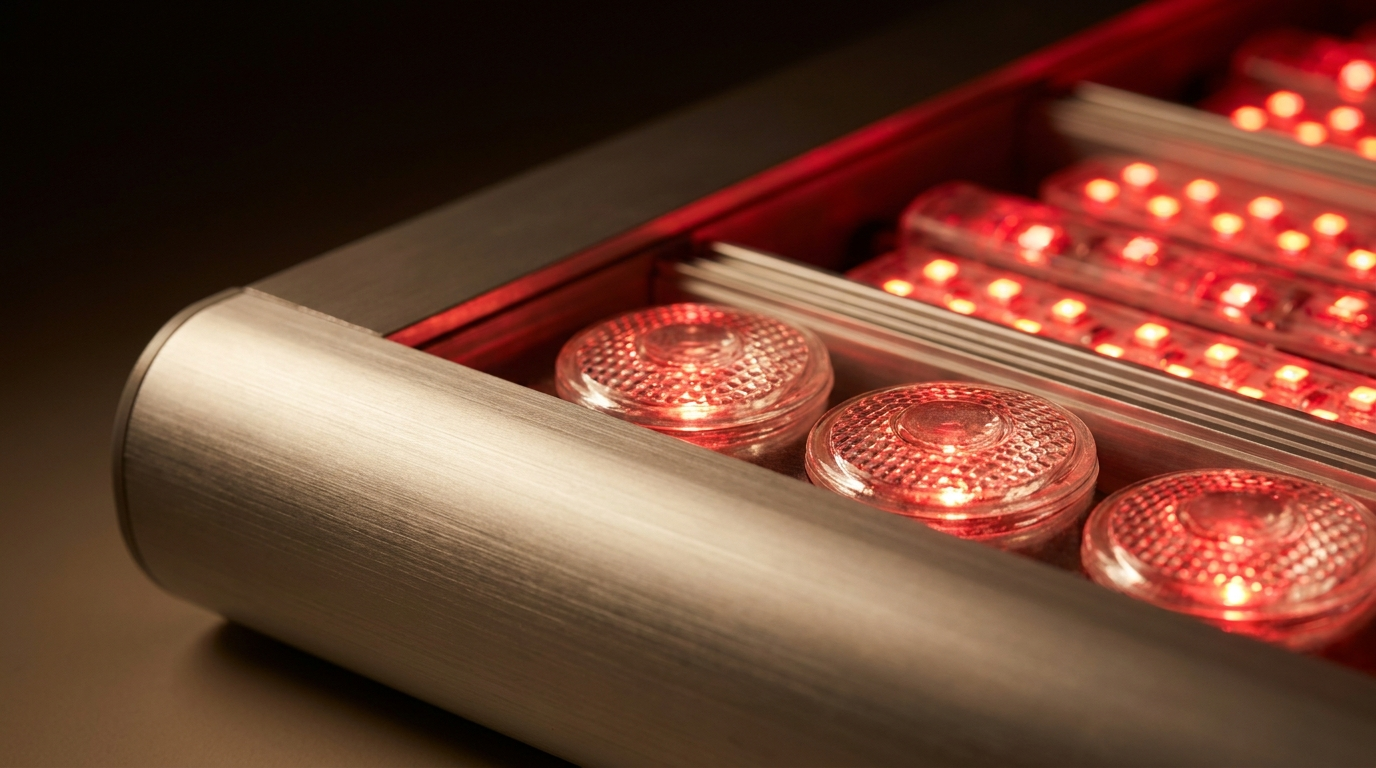
Red and near-infrared light therapy (often called photobiomodulation, or PBM) has decent evidence for improving skin texture, reducing fine lines, and speeding up some types of wound healing and joint pain, mostly at wavelengths of 630–670 nm (red) and 810–850 nm (near-infrared) delivered at doses of roughly 4–60 J/cm² per session. The catch: many consumer panels either don't disclose irradiance, require sitting much farther or longer than tested, or top out well under the energy density used in clinical trials. It plausibly works for the things it's been tested for, but the panel on your Instagram feed may not be delivering study-grade doses unless you check the numbers yourself.
How is red light therapy supposed to work?
The mechanism isn't mysterious hand-waving — it's fairly well mapped. Red and near-infrared wavelengths penetrate skin and get absorbed by cytochrome c oxidase, a component of the mitochondrial electron transport chain. This absorption is thought to transiently boost ATP production and trigger downstream signaling (including nitric oxide release and modest reactive oxygen species generation) that influences inflammation and collagen synthesis. Hamblin's 2017 review in AIMS Biophysics lays out this mechanism in detail and is the one most PBM papers cite as the mechanistic backbone. That part of the story holds up reasonably well in cell and animal models — the harder question is what happens when you shine a panel at a human face or knee for a few minutes a day.
What does the clinical research actually show?
The best skin-specific data comes from small randomized and split-face trials. A frequently cited one is Wunsch and Matuschka's 2014 study in Photomedicine and Laser Surgery, which tracked 136 participants using 611–650 nm and 570–850 nm LED devices over 30 sessions and found measurable increases in collagen density and improved skin complexion via ultrasound and photographic scoring. That trial used a fluence in the range of 8 J/cm² per treatment area, delivered several times a week for weeks — not a single five-minute zap.
For pain and musculoskeletal use, a Cochrane-adjacent systematic review (Chow et al., 2009, in The Lancet) on low-level laser therapy for neck pain found consistent short-term pain relief across pooled trials, with effective doses generally falling in the 5–60 J/cm² range depending on tissue depth and target. Wound healing studies use similar dose ranges, sometimes lower for superficial wounds.
Here's where it gets practically important: irradiance (mW/cm²) times time (seconds) gives you fluence (J/cm²), and doubling your distance from a panel doesn't halve your dose — it can cut it to a quarter or less, because light intensity drops off sharply with distance (roughly following the inverse square law near the source). A device advertised as high-powered at 6 inches away might deliver a fraction of that at 18 inches, which is where a lot of people actually sit.
How do home panels compare to the devices used in trials?
Most clinical trials used medical-grade LED arrays or low-level lasers with irradiance specs the manufacturer discloses and the researchers measured directly at the skin surface. Consumer panels vary enormously — some publish irradiance at a fixed distance, many don't. If a panel doesn't tell you mW/cm² at a specified distance, you genuinely cannot calculate whether you're anywhere near the studied dose, no matter how long you sit in front of it.
Clinical LED masks and in-office devices (the kind used in dermatology offices) tend to sit closer to the studied fluence because they're calibrated and positioned at fixed, close range for a set time. Home panels can absolutely work if they're bright enough and you're close enough, but "10 minutes a day" means very different things depending on the wattage and distance. A cheap panel used correctly (close range, right wavelength, adequate time) can outperform an expensive one used at the wrong distance.
Are there risks or limitations worth knowing about?
Red and near-infrared light at these doses are considered low-risk — no ionizing radiation, and adverse events in trials are mostly mild eye strain or transient redness if you're too close for too long. Eye protection matters more with high-powered near-infrared panels than most marketing acknowledges. The bigger limitation is evidentiary: most skin trials are small (dozens to low hundreds of participants), often industry-funded or run by device manufacturers, and long-term data (beyond a few months) is thin. It's not nothing, but it's also not the kind of evidence base you'd want to hang a dramatic anti-aging claim on.
FAQ
Q: How do I know if my home panel is delivering a real dose?
A: Check whether the manufacturer publishes irradiance (mW/cm²) at a specific distance. If they do, you can calculate fluence by multiplying irradiance by your session time in seconds and comparing it to the 4–60 J/cm² range used in the trials above. If they don't publish it, you're guessing.
Q: Is more light always better?
A: No — PBM research generally shows a biphasic dose response, meaning too little light does nothing and too much can blunt or reverse the benefit. This is one reason trial protocols specify exact fluence rather than "as much as tolerated."
Q: Does red light therapy help with acne or wrinkles specifically?
A: There's more consistent evidence for mild collagen/texture improvements (like the Wunsch and Matuschka trial) than for acne, where blue light (415 nm) targeting P. acnes bacteria has somewhat stronger support than red light alone.
Q: How long before I'd expect to see anything?
A: Skin studies generally ran sessions 3–5 times weekly for 8–12 weeks before measuring change. Anyone promising visible results after a handful of sessions is outrunning the data.
Sources
- Hamblin MR. Mechanisms and applications of the anti-inflammatory effects of photobiomodulation. AIMS Biophys. 2017.
- Wunsch A, Matuschka K. A controlled trial to determine the efficacy of red and near-infrared light treatment in patient satisfaction, reduction of fine lines, wrinkles, skin roughness, and increase in skin collagen. Photomed Laser Surg. 2014.
- Chow RT, et al. Efficacy of low-level laser therapy in the management of neck pain: a systematic review and meta-analysis of randomised placebo or active-treatment controlled trials. Lancet. 2009.
Medical Disclaimer
This content is for informational purposes only and is not a substitute for professional medical advice, diagnosis, or treatment. Always consult a qualified healthcare provider before making any health-related decisions or using any treatments discussed herein, including red light or near-infrared devices, especially if you have a photosensitivity condition or are taking photosensitizing medication. Results vary by individual.
of Stuff
The evidence, in your inbox. No sponsored placements inside a verdict, ever.