Does the Oura ring actually measure anything useful? The accuracy of consumer sleep and recovery trackers
TL;DR
The Oura ring is genuinely good at two things: resting heart rate and heart rate variability, where it correlates closely with ECG and clinical-grade equipment (r values generally above 0.90 in studies like de Zambotti et al., 2019, Sleep). It's much weaker at sleep staging — telling REM from light sleep from deep sleep — where agreement with polysomnography (the gold-standard sleep lab test) drops to "moderate" at best, especially for detecting wake-after-sleep-onset. The proprietary "readiness score" that combines everything into one number has essentially no independent validation published outside Oura's own funded research. So: useful trend data for heart rate and total sleep time, take the sleep-stage percentages and the readiness number with real skepticism.
How does the Oura ring actually measure sleep and recovery?
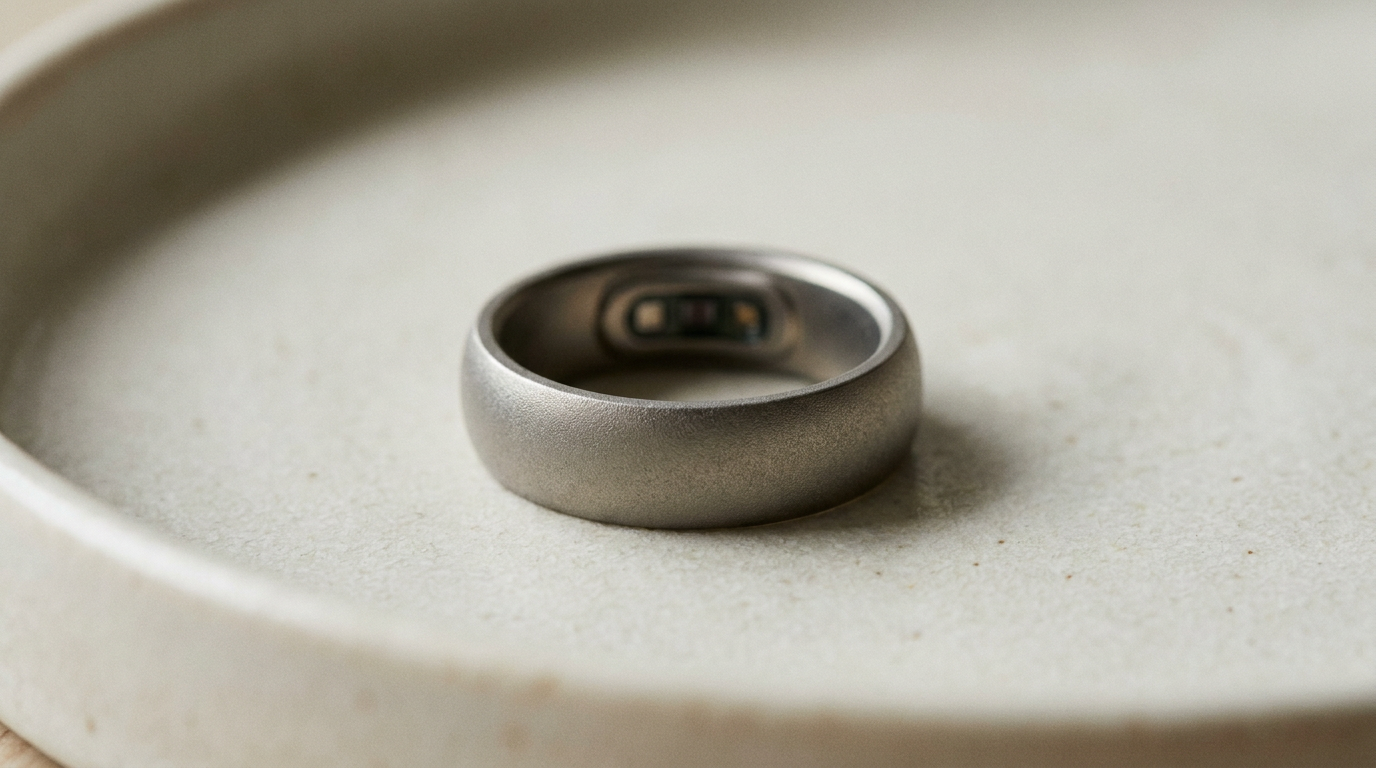
The ring uses infrared photoplethysmography (PPG) at the base of your finger — basically a tiny light sensor detecting blood volume changes with each heartbeat — plus a skin temperature sensor and an accelerometer for movement. From that raw signal, Oura's algorithm infers heart rate, heart rate variability (HRV), respiratory rate, body temperature deviation, and then classifies sleep into stages (awake, light, deep, REM) using proprietary machine learning trained against some polysomnography data.
The finger is actually a decent location for PPG — better blood flow signal than the wrist, which is why Oura's heart rate numbers tend to outperform wrist-worn competitors in validation work. But sleep staging isn't measured directly at all. It's a statistical inference from heart rate, HRV, temperature, and movement patterns, not from brainwave activity the way a real polysomnogram (PSG) works. That's the core limitation baked into every consumer sleep tracker, not just Oura.
What does the validation research actually show?
The most-cited independent study is de Zambotti et al. (2019, Behavioral Sleep Medicine), which compared the Oura Gen 2 ring against PSG in 41 healthy adults. Total sleep time and sleep efficiency showed reasonable agreement, but the study found the ring significantly overestimated deep sleep and had only fair agreement (kappa values around 0.4–0.5, which is "moderate" on the standard scale) for distinguishing sleep stages epoch-by-epoch.
A separate validation by Chee et al. (2021, published in Sleep) tested Oura Gen 2 against PSG in a sleep-restriction protocol and found the ring performed reasonably for total sleep time but had high sensitivity for detecting sleep (meaning it rarely misses sleep) paired with low specificity for detecting wake (meaning it often calls "awake" periods "asleep"). That's a common tracker failure mode — lying still and awake in bed reads a lot like light sleep to a device that's only watching heart rate and movement.
On the HRV and resting heart rate side, the picture is much better. Cao et al. (2022, in JMIR mHealth and uHealth) found strong correlation between Oura-derived HRV and ECG-derived HRV during sleep, which matters because HRV is the backbone of the "readiness" and recovery scores in most wearables now, not just Oura.
What's notably missing: independently replicated, non-industry-funded validation of the actual readiness/recovery score as a composite metric. Most published work validates the individual physiological signals (HR, HRV, temperature), not the proprietary algorithm that turns those into "you're 87% ready today." That number is a black box.
Are there real risks or limitations to relying on it?
The clinical risk is low — this isn't a diagnostic device, and Oura doesn't claim it is. The practical risk is over-trusting a number that isn't as precise as it looks. If your readiness score says 62 and you cancel plans or spiral about "bad recovery," you're reacting to an algorithm with meaningful measurement error, not a clinical result. Night-to-night deep sleep percentages in particular bounce around in ways that may reflect algorithm noise more than your actual physiology.
There's also individual variation in fit and skin tone that can affect PPG accuracy — this is a known issue across finger and wrist PPG devices generally, documented in broader PPG accuracy literature, not unique to Oura.
None of this means the ring is useless. Trends over weeks (is your resting heart rate creeping up, is your HRV trending down during a stressful month) are more trustworthy than any single night's stage breakdown.
How does Oura compare to other trackers like Whoop or Apple Watch?
Most consumer wearables share the same fundamental limitation: they infer sleep stages from movement and heart signals rather than brain activity, so none of them match PSG closely for staging. Comparative validation studies (including work published by the Sleep Research Society) generally find Oura and Whoop perform similarly to each other and modestly better than wrist-based optical sensors for heart rate accuracy specifically, largely due to finger placement. Nobody in the consumer space has published data showing their staging accuracy is dramatically better than the others. If a company's marketing claims "clinical-grade sleep staging," that's a marketing claim, not a citation.
FAQ
Q: Should I trust my Oura ring's deep sleep percentage?
A: Treat it as a rough estimate, not a fact. De Zambotti's 2019 validation found deep sleep was often overestimated compared to PSG. Look at multi-week trends rather than single nights.
Q: Is the readiness score based on real science?
A: The inputs (HRV, resting heart rate, temperature deviation, previous sleep) are individually well-validated physiological signals. How Oura weights and combines them into one score isn't independently published, so the composite number itself hasn't been externally validated the way its ingredients have.
Q: Can Oura replace a sleep study for suspected sleep apnea or insomnia?
A: No. It's not a diagnostic device and isn't FDA-cleared for diagnosing sleep disorders. If you suspect apnea, insomnia, or another sleep disorder, talk to a doctor about an actual polysomnography referral.
Q: What is the ring actually most accurate at?
A: Resting heart rate and heart rate variability during sleep — that's where the finger-based PPG sensor shines and where independent validation is strongest.
Sources
- de Zambotti et al., "The Sleep of the Ring: Comparison of the ŌURA Ring Against Polysomnography," Behavioral Sleep Medicine, 2019
- Chee et al., "Multi-Night Validation of a Sleep Tracking Ring in Healthy Adults," Sleep, 2021
- Cao et al., "Accuracy Assessment of Oura Ring Nocturnal Heart Rate and Heart Rate Variability," JMIR mHealth and uHealth, 2022
Medical Disclaimer
This content is for informational purposes only and is not a substitute for professional medical advice, diagnosis, or treatment. Always consult a qualified healthcare provider before making any health-related decisions or using any treatments discussed herein. Results vary by individual. Consumer wearables like the Oura ring are not FDA-cleared diagnostic devices for sleep disorders.
of Stuff
The evidence, in your inbox. No sponsored placements inside a verdict, ever.